
Walk into any wellness store right now and you'll find red light panels, LED masks, and handheld wands promising to fix your skin, reverse aging, and eliminate pain. The marketing lumps all of it under 'light therapy' — as if wavelength, power, and target tissue didn't matter at all.
They matter enormously. So let's untangle the three main categories, be clear about what each one is actually good for, and talk about how the Epoch Helios 980 — including their CBD/CBG topical — fits into a practical home recovery routine.
Red Light Therapy: The Skincare Tool
Consumer red light therapy devices emit light in the 630–700 nm range — visible red light. At these wavelengths, light penetrates only a few millimeters into the skin. That's not a flaw — it's actually the right depth for skin-level concerns.
What red light therapy is genuinely good for:
• Fine lines and wrinkles — stimulates fibroblasts to produce collagen
• Skin tone and texture — reduces redness, evens pigmentation over time
• Mild surface acne — reduces inflammation and bacterial activity at the skin level
• Post-procedure recovery — can support healing after chemical peels or microneedling
• General skin rejuvenation with consistent daily use
Consumer LED panels and masks can be effective for these purposes — but only with consistent use over weeks to months, and only at the skin surface. They don't penetrate into muscle, tendon, or joint tissue in any meaningful way.
Think of consumer red light therapy as a long-game skincare routine, not a treatment for pain or injury.
Clinical Laser Therapy for Skin: A Different Category Entirely
When patients ask about laser therapy for skin — melasma, deep pigmentation, acne scarring, age spots — they're entering a completely different category. Clinical skin lasers like Q-switched Nd:YAG devices operate at wavelengths designed to target melanin and hemoglobin in skin layers. These are professional devices used only in clinical settings.
What clinical skin lasers are used for:
• Melasma and stubborn deep pigmentation
• Sun damage and age spots
• Acne scarring and post-inflammatory hyperpigmentation
• Skin tightening and collagen remodeling
• Tattoo removal
Sessions take 15–30 minutes and are performed by trained providers. Results develop over 2–3 months as the skin regenerates. There's typically some recovery — redness, mild sensitivity — and aftercare matters (sun protection, avoiding retinoids and heat for 24–48 hours post-treatment).
This is a clinical treatment, not a home device. It belongs in a provider's office, and that's a good thing — these are real interventions that require real expertise.
Photobiomodulation at 980 nm: A Completely Different Goal
Near-infrared light at 980 nm doesn't care much about your skin. It passes through it.
That's the entire point. The 980 nm wavelength is specifically chosen because it bypasses absorption by melanin and hemoglobin at the skin surface, allowing it to penetrate several centimeters into the body — reaching muscles, tendons, ligaments, nerves, and even bone. The therapeutic target isn't the skin; it's everything underneath it.
At that depth, the light interacts with cytochromes inside mitochondria, stimulating cells to produce more ATP — the molecule that powers tissue repair. The cascade of effects includes reduced inflammation, improved local circulation, faster tissue regeneration, and decreased pain signaling. This is photobiomodulation, and it's what Class IV medical lasers have been doing in clinical settings since 2003.
It's particularly effective for:
• Sprains, strains, and ligament injuries
• Tendon conditions — Achilles, rotator cuff, plantar fasciitis, tennis elbow
• Chronic joint inflammation and arthritis
• Peripheral neuropathy
• Bone stress injuries and stress fractures
• Post-workout muscle recovery
This is not a skin treatment. It's a healing treatment. Different wavelength, different target tissue, different goal entirely.
The Epoch Helios 980: Bringing 980 nm Home
The Epoch Helios 980 is a portable 980 nm near-infrared device designed for home use. It was literally created because a patient — a professional organist with severe arthritis — asked Epoch's founder for something she could use between clinic visits. That origin story matters: this is a maintenance and between-session tool, not a replacement for clinical care.
At $599, it sits at a fraction of the cost of the clinical Epoch 980 system (which is used in physician and physical therapy offices), and it's designed to be used independently at home once you've been guided on proper use.
Q: What does it actually do?
It delivers 980 nm near-infrared light over a contact pad that attaches to the body with velcro straps — so you're not holding it during treatment, just resting while it works. The single-wavelength approach means all the energy is focused on the therapeutic 980 nm band rather than being spread across multiple wavelengths like consumer LED panels.
Q: What conditions does it help with at home?
• Arthritis and chronic joint discomfort
• Ongoing tendon and soft tissue conditions after the acute phase
• Post-workout muscle recovery and soreness
• Maintenance between clinical laser sessions
• Sports injuries — sprains, strains — during the healing phase
• Neuropathy and nerve-related discomfort
Q: Is it safe to use without supervision?
The device is designed with home safety in mind. It has multiple power settings and a 30-minute automatic shutoff to prevent overexposure. That said, like any therapeutic device, there are precautions. Avoid use over areas of known cancer, near the eyes, over the thyroid, on the abdomen or low back during pregnancy, or over areas of active bleeding. When in doubt, check with your provider first.
Q: Who is it NOT right for?
If you're dealing with a new acute injury — fresh significant swelling, suspected fracture, or a problem you haven't had evaluated — start with a clinical assessment first. The Helios 980 is a maintenance and recovery tool. A Class IV clinical laser delivers considerably more power with guided therapeutic protocols. The Helios bridges the gap between visits; it's not a substitute for them.
The CBD/CBG Topical: Why 'Light Transparent' Matters
This is where the Epoch protocol gets genuinely clever — and where I want to spend a moment because it's often the part patients are most curious about.
Epoch produces a Light Transparent Full Spectrum CBG/CBD Oil specifically designed to be used in conjunction with the Helios. The name isn't marketing language — it's functional. Most topical oils and creams contain ingredients that absorb or scatter light, which would reduce the laser's penetration. This formulation is specifically tested to be transparent to 980 nm light, meaning you can apply it before or during treatment without interfering with the device's effectiveness.
What's in it and why it matters:
• 500 mg full spectrum CBG/CBD blend — CBG (cannabigerol) and CBD both have well-documented anti-inflammatory and analgesic properties at the tissue level
• Less than 0.04% THC — well below the legal limit of 0.3%, and essentially non-detectable in testing
• Formulated to absorb quickly and cleanly — only a small amount is needed for localized treatment areas
• Designed to complement, not compete with, the laser's mechanism of action
The thinking behind combining the two: photobiomodulation increases cellular permeability and local circulation in treated tissue. Applying a targeted anti-inflammatory topical to that same area — one that won't block the light — creates a layered approach where both the laser and the topical are working on the same tissue at the same time.
It's a thoughtful pairing, not a gimmick. The formulation specificity is what separates it from simply reaching for any CBD cream off the shelf.
If you want to try the Epoch Helios 980 or the Light Transparent CBG/CBD Oil, use code PLANTSTRUCK10 at checkout for 10% off both products.
How They Compare at a Glance
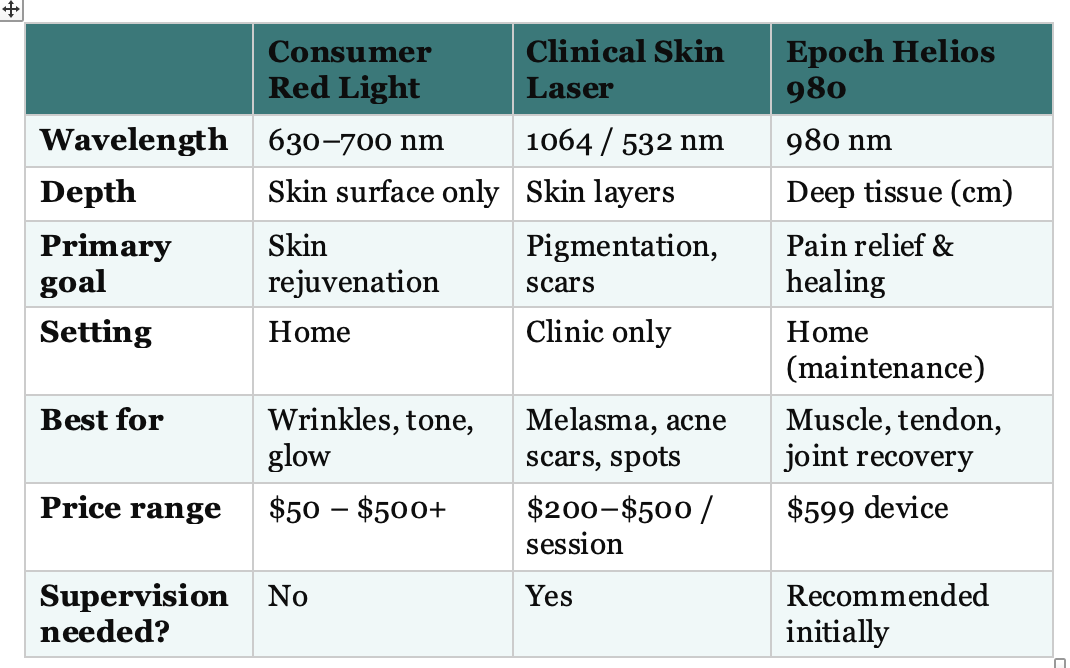
So Which One Do You Need?
Here's a practical way to think about it:
• You want better skin — softer texture, reduced redness, a healthier glow? A quality consumer red light panel used consistently is a reasonable starting point.
• You have melasma, acne scarring, or sun damage that isn't responding to topicals? Talk to a provider about clinical laser options. This isn't a home category.
• You're managing pain, recovering from a muscle or tendon injury, or dealing with arthritis or neuropathy? Photobiomodulation — either in-clinic or with the Helios 980 at home — is worth a serious look.
• You're already receiving clinical laser therapy and want to extend and maintain the benefit between sessions? The Epoch Helios 980, paired with the Light Transparent CBG/CBD Oil, is designed precisely for that role.
These aren't competing tools — they're different tools for different jobs. The confusion comes almost entirely from marketing that groups them all under 'light therapy' as if wavelength and depth of penetration don't matter. They're the whole story.
The Bottom Line
Light therapy is a real category with real science behind it — but wavelength, power, and target tissue determine everything. A consumer red light mask and a 980 nm near-infrared device are no more interchangeable than a topical moisturizer and a cortisone injection.
Know what you're treating. Match the tool to the tissue. And for anything involving pain, injury, or recovery, start with a clinical evaluation so you're working with a plan rather than guessing.
The right wavelength for the right tissue — at the right time in your recovery. That's the whole story.
Ready to try it? Use code PLANTSTRUCK10 at epochlasers.com for 10% off the Epoch Helios 980 and the Light Transparent CBG/CBD Oil.
Stay Plant Struck,
Dr. Deb
